
Does Coffee Slow Aging? New Cell Study Explains

Every morning, millions of people worldwide rely on a steaming cup of coffee to wake up and boost their daily mental focus. However, recent scientific inquiries reveal that caffeine does far more than just stimulate the human central nervous system. Beneath the surface, this ubiquitous molecule quietly interacts with complex molecular pathways that govern cell survival, stress management, and biological longevity. Does Coffee Slow Aging? New Cell Study Explains
Read More: how much coffee causes osteoporosis
Unraveling the Mystery of Healthy Aging
For decades, medical researchers have observed intriguing statistical links between moderate coffee consumption and a reduced risk of age-related chronic conditions. Consequently, understanding the exact intracellular mechanisms driving these longevity benefits has become a top priority for cell biologists. While earlier assumptions focused primarily on antioxidant properties, modern genetic tools now allow scientists to observe how caffeine interacts directly with ancient, evolutionarily conserved signaling networks inside living cells.
Key Research Metadata, Investigators, and Timeline
A dedicated team of geneticists and cell biologists recently uncovered groundbreaking insights into how caffeine interacts with foundational cellular machinery.
- Lead Researchers: The investigation was led by postdoctoral research scientist Dr. John-Patrick Alao alongside senior author Dr. Charalampos (Babis) Rallis.
- Research Institution: The study was conducted at the Cellular Ageing and Senescence Laboratory within the Centre for Molecular Cell Biology at Queen Mary University of London.
- Publication Timeline: Originally published in the peer-reviewed journal Microbial Cell.
Experimental Model and Methodological Approach
To observe fine cellular interactions without human biological noise, researchers selected a highly reliable single-celled eukaryotic model organism.
- Model Organism: The team utilized fission yeast (Schizosaccharomyces pombe), often nicknamed “mini-humans” because they share crucial metabolic and cell-cycle pathways with human cells.
- Target Pathway Exploration: Scientists monitored cell cycle regulation, cellular growth responses, DNA damage sensitivity, and overall lifespan under varying caffeine dosages.
- Genetic Mapping: Researchers systematically analyzed how caffeine alters signaling through the TOR (Target of Rapamycin) pathway versus the AMPK (AMP-activated protein kinase) energy-sensing pathway.
Surprising Discovery: Flipping the AMPK Energy Switch
Biologists previously believed that caffeine influenced cellular lifespan strictly by directly inhibiting TOR, a master growth regulator that senses nutrient availability. However, this latest investigation revealed a fascinating evolutionary twist in how caffeine operates at the molecular level.
- Indirect TOR Regulation: Instead of targeting TOR directly, caffeine first triggers AMPK, an ancient energy-sensing enzyme that acts when cellular resources run low.
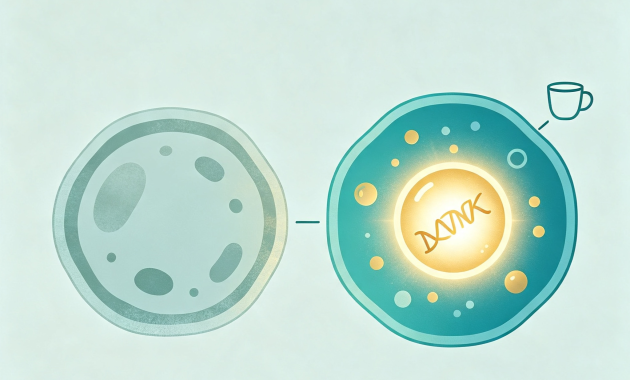
- Activating Survival Mechanisms: Once caffeine flips the AMPK switch, cells initiate essential maintenance tasks, including enhanced DNA repair, structural stress resistance, and regulated cell growth.
- Shared Evolutionary Lineage: Because AMPK mechanisms remained conserved through millions of years of evolution, findings in fission yeast provide crucial clues regarding human cellular health.
Broader Implications for Human Longevity Research
Understanding how caffeine interacts with AMPK opens exciting new avenues for anti-aging medicine and metabolic therapeutic design. Furthermore, AMPK is the very same target activated by well-known longevity drugs like metformin and interventions like caloric restriction. While researchers caution that yeast studies require further human clinical validation, this discovery proves that a daily cup of coffee engages deeply rooted biological defense mechanisms that help cells resist age-related decline.
Research Conclusion
- Primary Molecular Mechanism: Caffeine promotes cellular longevity not by acting directly on TOR, but by flipping the ancient AMPK energy-sensing switch.
- Cellular Defense Activation: Triggering the AMPK pathway enhances critical cell survival functions, including robust stress resistance, controlled growth, and improved DNA repair mechanisms.
- Evolutionary Conservation: Because AMPK signaling pathways are biologically conserved between fission yeast and human cells, these findings offer a clear molecular explanation for coffee’s observed anti-aging benefits.
- Therapeutic Potential: Uncovering caffeine’s interaction with AMPK aligns it with known longevity interventions like caloric restriction, paving the way for future healthy aging research.
How Caffeine May Trigger a Cellular Switch Linked to Slower Aging
This short video provides a quick visual summary explaining how caffeine activates the ancient AMPK cellular switch linked to DNA repair and healthier aging. Does Coffee Slow Aging? New Cell Study Explains